
One Soldier Can Deliver Affordable, Precision Massed Fires, Test Shows
HUNTSVILLE, Ala., Oct. 12, 2026

Press Release Disclaimer: This is a press release distributed through the XPR Media network. It has not been independently verified by our newsroom.

One Soldier Can Deliver Affordable, Precision Massed Fires, Test Shows
PR Newswire
HUNTSVILLE, Ala., Oct. 12, 2026
Multiple Cummings Aerospace Hellhound S3 Effectors Execute Autonomous Missions in First Vehicle-Mounted Launch
HUNTSVILLE, Ala., Oct. 12, 2026 /PRNewswire/ — Soldiers moved one step closer to being able to affordably deliver precision massed fires.
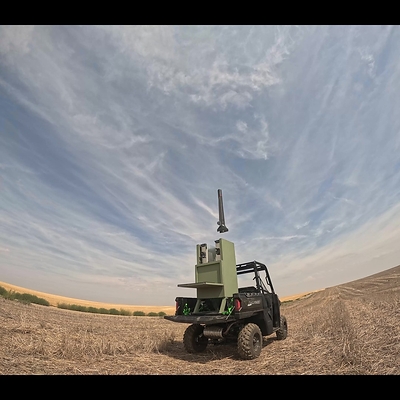
During a recent test, a Cummings Aerospace engineer used a single fire control system to sequentially fire two Hellhound S3 multi-mission effectors from a new launcher mounted on a utility vehicle. Both Hellhounds executed autonomous missions while the operator used the FCS to simultaneously monitor both S3s in real time.
The Cummings Hellhound S3 is 3D-printed, weighs about 13 pounds, and is roughly the size of a baseball bat. It’s built via a combination of additive manufacturing and commercial off-the-shelf components, making it affordable and enabling Cummings to deliver more than 100 systems a month. Thanks to a turbojet engine, it can fly further than 60 kilometers at speeds of up to 384 miles per hour, and can carry different payloads depending on the mission.
Why it matters
“This test changes the battlefield equation for our Soldiers,” said Sheila Cummings, CEO of Cummings Aerospace. “Instead of having to manually fly a single drone or effector to a target, one Soldier using one FCS can simultaneously put multiple Hellhounds on multiple targets.”
During the test and prior to launch, the operator programmed each Hellhound’s mission — waypoints, altitudes, and flight paths — from the handheld FCS. After launch, the Hellhounds autonomously executed those missions, navigating complex pre-designated flight paths without manual flight control. The S3s simultaneously sent and received data to-and-from the FCS, enabling the operator to monitor both flights in real time and adjust or abort the missions as needed.
“The S3’s speed and range enable Soldiers to compress the kill chain,” said Sheila Cummings. “Controlling several S3s from one handheld system lets a small unit produce fires that used to take an entire battery.”
First Steps Toward Unmanned-Vehicle Organic Massed Fires
While Hellhound has been flight-tested more than a dozen times in its man-portable configuration, this test marks the first time Hellhound was fired from a vehicle. Other firsts for the test include:
• The first use of a new launcher designed to fire as many as eight Hellhounds.
• The first ripple-fire of the Hellhound S3.
• The first time a single operator controlled multiple Hellhounds simultaneously from one handheld fire control system.
In the future, Cummings Aerospace will:
• Salvo-fire the Hellhound S3 from the multi-pack launcher.
• Fire the Hellhound S3 from a multi-pack launcher mounted to an unmanned ground vehicle.
• Take the Hellhound S3 to sea by firing it from a multi-pack launcher mounted to an unmanned surface vehicle.
About the test
• When: Aug 25, 2026
• Where: Pendleton UAS Range, Ore.
• Two Hellhound S3s, carrying inert payloads, were sequentially fired from a Polaris utility vehicle.
• The two Hellhounds flew at different pre-determined flight profiles and speeds, demonstrating how the systems might be employed in an operational setting.
• The test met all objectives.
One Platform, Multiple Missions, Many Effects
Hellhound is a versatile, multi-mission effector. Depending on the needs of the mission, operators can direct the Hellhound S3 to serve as a:
• Loitering munition
• Precision-guided munition
• One-way attack drone
• Counter-UAS
Hellhound’s modular, open-systems architecture gives commanders additional flexibility to deliver battlefield effects. Four interchangeable mission modules can be field-swapped in less than two minutes, without tools:
• Armor-piercing module
• Electronic warfare module
• Decoy module
• Blast-fragmentation module
Depending on mission requirements, the system can fly slowly or accelerate to speeds in excess of 384 miles per hour.
The multi-pack launcher can be lifted by two people and easily mounted on a variety of vehicles in the Army’s inventory.
About the Hellhound Family
Hellhound is a family of low-cost, modular, multi-mission effectors.
• Hellhound S3: Turbojet-powered, 3D-printed multi-mission effector. In its man-portable configuration, the all-up round, launch canister and ground control system weigh less than 25 pounds, allowing single-Soldier deployment. In its vehicle-mounted configuration, up to eight Hellhounds can be fired from a launcher that can be mounted on any crewed or unmanned ground vehicle.
• Hellhound S4: Tube-launched multi-mission effector. At 58 inches and 45 pounds in its canister, the S4 can be set up and launched by a single Soldier, from ground, sea or air platforms. It can reach targets 130 to 140 km away, has more than 1.5 hours of flight time, and can support missions including low-cost cruise missile effector, and gap-filling Intelligence, Surveillance and Reconnaissance coverage for Golden Dome.
About Cummings Aerospace
Cummings Aerospace, a Native American Woman‑Owned Small Business headquartered in Huntsville, Alabama, is an aerospace engineering company delivering responsible weapon‑system solutions for defense modernization and readiness. The company’s expertise includes the design, development, production, and sustainment of missile systems, hypersonic vehicles, radars, command‑and‑control systems, and associated technologies.

 View original content to download multimedia:https://www.prnewswire.com/news-releases/one-soldier-can-deliver-affordable-precision-massed-fires-test-shows-302905178.html
SOURCE Cummings Aerospace


