Terradot and Google Combine Superpollutants and Carbon Removal in the World’s Largest Enhanced Rock Weathering Project in Southern Brazil
Novel approach addresses both methane and carbon dioxide removal and marks Google's largest carbon removal purchase to

Press Release Disclaimer: This is a press release distributed through the XPR Media network. It has not been independently verified by our newsroom.


Terradot, a leader in enhanced rock weathering (ERW), and Google today announced a megaton-scale climate project in Southern Brazil that pairs methane avoidance in rice farming with permanent carbon dioxide removal (CDR). Google will purchase 1M tonnes of near-term methane impact by 2030 and 1M tonnes of carbon removal impact by 2040, making this its largest carbon removal purchase to date. It is also the largest ERW project ever undertaken, and the first project of any kind to combine near-term methane elimination with durable carbon removal at this scale.
This press release features multimedia. View the full release here: https://www.businesswire.com/news/home/20260916056109/en/
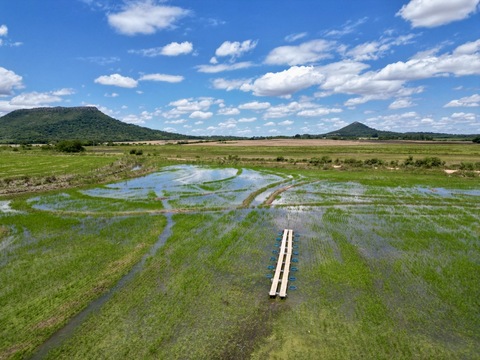
Enrolled rice fields in Rio Grande do Sul
Climate change has two problems on two timelines. The first is near-term warming, driven by superpollutants like methane. Methane is responsible for roughly one-third of human-caused warming to date, but it clears the atmosphere within about a decade. Cutting it now brings relief within years. The second challenge is long-term warming, driven by carbon dioxide, which accumulates and keeps heating the planet for centuries. Most climate solutions address one problem or the other.
This project addresses both problems by turning Brazilian rice systems into a comprehensive climate solution. Terradot will help rice farmers across more than 200,000 hectares starting in Rio Grande do Sul adopt Alternate Wetting and Drying (AWD), an irrigation practice that periodically drains flooded paddies, cutting water use and sharply reducing the methane they release to create an immediate though short-lived climate impact. At the same time, Terradot spreads naturally sourced, crushed volcanic rock on farmland to generate durable carbon removal. By the time the short-lived methane impact has expired, the long-lived carbon removal impact will be realized. Farmers benefit too: AWD has the potential to lower water and input costs, and the crushed rock improves soil health, giving them a direct stake in the climate impact their land helps create.
“For years, climate action has been framed as a choice, either move fast on the warming happening now or remove carbon permanently. Our project with Google eliminates that trade-off,” said James Kanoff, CEO of Terradot. “We are pairing two proven technologies and deploying them together at a massive scale. With this new model, every tonne of removal meets the same rigorous standard, and delivers climate impact faster than ever.”
In ERW, there’s a natural delay between rock spread and realizing its full climate impact. That delay is driven by the time it takes for rock to dissolve and for the resulting alkalinity to be durably stored. Today, ERW handles that delay through frequent measurements to capture small changes in rock weathered, conservative discounting and project finance to carry the cost of deployment ahead of crediting CDR that is generated in shallow soil – each of which adds cost without adding climate benefit. This project handles the delay differently by waiting longer to credit the CDR, reducing measurement costs and uncertainty and pulling forward climate impact with paired AWD credits. Measured on a temperature-over-time basis, the combined impact is a net decrease in warming.
“Google and Terradot are weaving together technologies that allow for rigorous validation and scaling to bend the warming curve in our lifetimes,” said Scott Fendorf, PhD, Chief Scientific Advisor and Co-founder of Terradot.
A record of enhanced rock weathering at commercial scale
Terradot’s record of ERW deployments, extended by its February 2026 acquisition of Eion, pairs frontier science with commercial projects across two continents. The company is already delivering independently verified credits, with more than 500kt rock deployed and 20,000 ha treated. Data from every deployment over the past five years feeds into an intelligence platform used to identify the strongest project sites, optimize how rock is applied, and verify each tonne removed.
Google’s largest carbon removal purchase
For Google, the project is a working instance of the approach it set out in its 2026 environmental report: pairing action on superpollutants – which reduces warming quickly – with durable removal that phases in as that near-term impact expires. In May, Google published a paper providing comprehensive guidelines on combining CDR with superpollutant abatement.
“We built this agreement to be a template, not a one-off,” said Randy Spock, Head of Carbon Removal at Google. “It’s the largest carbon removal purchase Google has ever made, and by incorporating action on superpollutants, we realize that impact by 2030. We think it provides a replicable path to making a real dent in climate change in both the near and long term, and we’ve structured it so any buyer, supplier, or government can follow this same approach.”
Solving climate change with Brazilian agriculture
Southern Brazil is among the most favorable places in the world for this work. Tropical soils, a warm and wet climate, and flooded rice systems all accelerate weathering, and basalt quarries sit close to the farmland where the rock is applied. Brazil has more than 1.5 million hectares of rice under cultivation, and this project is explicitly designed to be replicable across those hectares, and eventually across other rice-growing regions worldwide. Built around the rice farmers of Rio Grande do Sul, Terradot and Google’s project brings investment and technical support into rural communities across the region and places it at the front of a global climate solution.
As part of the project, Google is providing an R&D grant to both Terradot and to Stanford Doerr School’s Soil & Environmental Biogeochemistry Lab to strengthen the scientific foundation of AWD as a methane mitigation strategy. Findings will be published and shared publicly, building an open, region-specific evidence base to support high-integrity methane crediting as AWD scales to new geographies.
About Terradot
Founded in 2022 by Stanford scientists and entrepreneurs, Terradot is the leading Enhanced Rock Weathering (ERW) platform, with deployments across Brazil and the United States. The company has raised $58 million from investors including Google, Microsoft, Gigascale Capital and individual backers including Sheryl Sandberg, John Doerr, and George Roberts. Terradot has signed committed offtake agreements with buyers including Google, Frontier, Microsoft, JP Morgan, and more. The company has issued Isometric certified credits under the Enhanced Weathering in Agriculture protocol as well as Puro certified credits from its US operations following the 2026 acquisition of Eion. Terradot’s science team, led by co-founder Professor Scott Fendorf in the Stanford Doerr School of Sustainability, includes leading geochemists and soil scientists whose work underpins Terradot’s approach to MRV and deployment optimization. Terradot is targeting 1 million tonnes of CO2 removal annually by 2035. For more information, visit www.terradot.earth
View source version on businesswire.com: https://www.businesswire.com/news/home/20260916056109/en/
Media gallery