Woodworking Tool Market Advances Toward USD 35.51 Billion as Modern Production Needs Support 3.51% Annual Growth
The Woodworking Tool Market is witnessing a surge in technological innovations, with manufacturers integrating smart

Press Release Disclaimer: This is a press release distributed through the XPR Media network. It has not been independently verified by our newsroom.
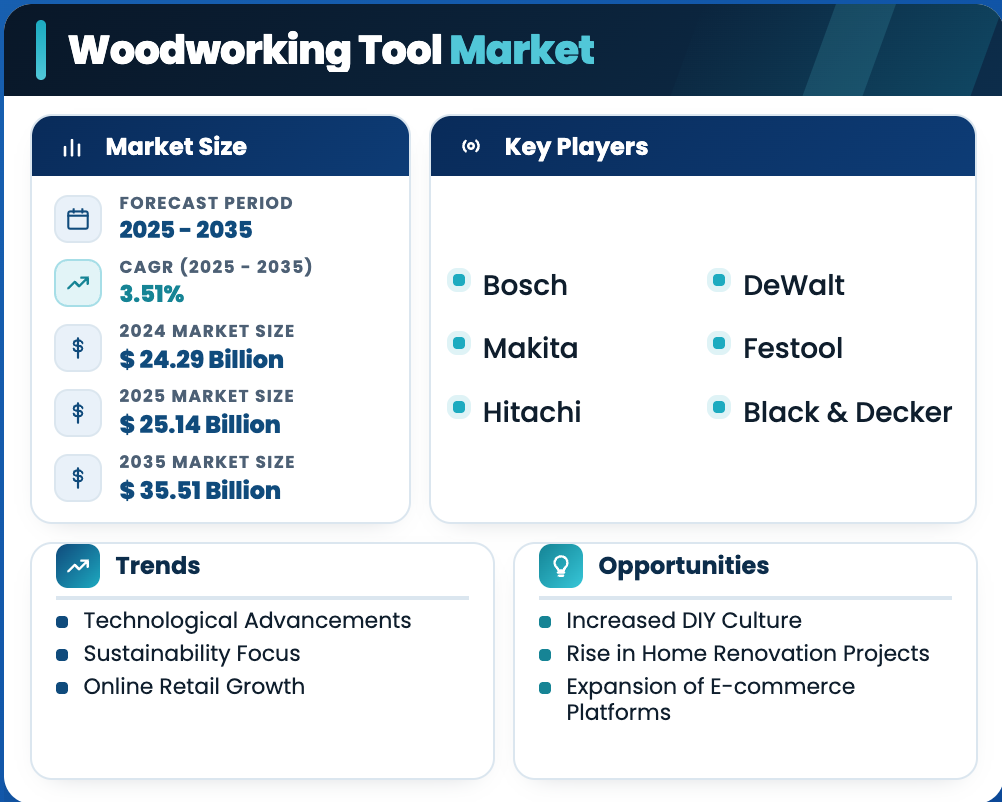

The Woodworking Tool Market is witnessing a surge in technological innovations, with manufacturers integrating smart features into their products.
NEW YORK, NY, UNITED STATES, August 26, 2026 /EINPresswire.com/ — The Woodworking Tool Market was estimated at 24.29 USD Billion in 2024. The woodworking tool industry is projected to grow from 25.14 USD Billion in 2025 to 35.51 USD Billion by 2035, exhibiting a compound annual growth rate (CAGR) of 3.51% during the forecast period 2025 – 2035.
Market Overview
Woodworking tools encompass a broad range of equipment and instruments used for cutting, shaping, joining, finishing, and assembling wood materials in both professional and hobbyist applications. These tools include power tools, hand tools, measuring and marking tools, cutting tools, planing and shaping tools, drilling tools, fastening tools, sanding and finishing tools, clamping tools, and woodturning tools. The market serves diverse end-users including professional woodworkers, construction professionals, furniture manufacturers, DIY enthusiasts, and hobbyists. Woodworking tools are essential across furniture manufacturing, cabinetry, construction, flooring, musical instrument making, and custom woodworking applications.
The Woodworking Tool market Size is experiencing steady growth driven by several key factors. The increasing demand for customized wooden products and furniture in both residential and commercial spaces is a primary growth driver. The growing DIY culture and home improvement trend, particularly among millennials and Gen Z seeking sustainability and personalization, is fueling demand for quality tools. The rise of online tutorials and home renovation shows is encouraging consumers to engage in woodworking projects. The construction industry’s ongoing demand for woodworking tools, driven by building standards evolution and sophisticated construction methods, continues to support market growth.
Key industry trends shaping the woodworking tool market include the integration of smart technologies and IoT connectivity in tools for enhanced control, precision, and user tracking. The increasing adoption of cordless and battery-powered tools, driven by lithium-ion battery technology offering longer runtime and faster charging, is gaining momentum. The growing focus on ergonomic designs and user comfort, reducing fatigue during prolonged use, is shaping product development. Manufacturers are also investing in sustainable materials and eco-friendly practices, aligning with consumer preferences for environmentally responsible products.
The market is also benefiting from technological advancements in tool design and manufacturing. Innovations in materials, including carbon fiber for lightweight high-strength tools and advanced steel alloys for durability, are enhancing performance. The development of precision tools with improved cutting and finishing capabilities is responding to rising quality demands from both professionals and hobbyists. Advances in battery technology and motor efficiency are extending the capabilities of cordless tools.
The demand outlook for woodworking tools remains positive, supported by sustained furniture and construction industry growth, expanding DIY participation, and technological innovation driving tool upgrades. The increasing popularity of woodworking as a hobby and the professional demand for customized wood products ensures steady market growth throughout the forecast period.
Get Free Sample Report for Detailed Market Insights:
https://www.marketresearchfuture.com/sample_request/23582
Market Segmentation
By Tool Type: The market is segmented by tool type into power tools, hand tools, measuring and marking tools, and other specialized tools. Power tools dominate the woodworking tool market, driven by their efficiency, precision, and increasing adoption in professional applications. Hand tools maintain steady demand for precision work and traditional woodworking methods.
By Application: The market is categorized into carpentry, furniture making, wood flooring, musical instrument making, DIY projects, and repair and maintenance. Carpentry holds the largest market share, driven by residential and commercial construction demand. DIY projects represent the fastest-growing segment, fueled by the rising popularity of home renovation and personal crafting. Furniture making remains a significant segment with consistent demand.
By End-User: The market serves professional woodworkers, construction professionals, furniture manufacturers, hobbyists and DIY enthusiasts, and industrial users. Professional woodworkers represent the largest segment, driven by demand for customized wooden products. Hobbyists and DIY enthusiasts represent the fastest-growing segment, supported by expanding DIY culture.
By Distribution Channel: The market is segmented into online retailers, home improvement stores, tool specialty stores, and direct sales. Online retailers hold the largest share, driven by e-commerce growth and consumer preference for convenient shopping. Home improvement stores are the fastest-growing segment, benefiting from rising DIY interest and hands-on shopping experience.
By Region: The market is analyzed across North America, Europe, Asia-Pacific, Latin America, and the Middle East and Africa. North America is the largest regional market, while Asia-Pacific is the fastest-growing region.
You can buy this market report at:
https://www.marketresearchfuture.com/checkout?currency=one_user-USD&report_id=23582
Regional Analysis
North America: North America holds approximately 40% of the global woodworking tool market share, driven by a robust DIY culture, increasing home improvement projects, and rising woodworking hobby participation. The United States leads the region, supported by strong construction activity, professional woodworking demand, and regulatory support for manufacturing standards. Canada’s woodworking and construction sectors contribute to demand. The region’s focus on innovation and high-quality, durable tools drives market growth.
Europe: Europe is a significant market driven by strong furniture manufacturing, construction activity, and craftsmanship traditions. Germany, the UK, France, and Italy are key markets with well-established woodworking and furniture industries. The region’s focus on quality, precision, and sustainable materials supports demand for advanced woodworking tools. Regulatory standards for tool safety and performance influence product development.
Asia-Pacific: Asia-Pacific is the fastest-growing woodworking tool market, driven by rapid urbanization, industrialization, and expanding construction activity across major economies. China dominates the region with extensive furniture manufacturing and construction sector. India is emerging as a significant market, driven by urbanization and growing DIY participation. Japan and South Korea are mature markets with advanced manufacturing technology adoption. Southeast Asian countries including Vietnam, Indonesia, and Thailand are experiencing growth from furniture export manufacturing and construction expansion.
Latin America: The Latin American market is developing, with Brazil and Mexico as key markets. Construction activity and furniture manufacturing drive tool demand. Growing DIY culture in urban centers supports market expansion.
Middle East and Africa: The region presents emerging opportunities driven by infrastructure development and construction activity. UAE, Saudi Arabia, and South Africa are key markets. Growing interest in woodworking and home improvement supports demand.
Competitive Landscape / Key Players
The global woodworking tool market is characterized by a mix of established global manufacturers and specialized tool companies. Key companies operating in the market include:
Stanley Black & Decker: A global leader in tools, offering comprehensive woodworking tool solutions including hand tools and power tools. The company’s broad portfolio and brand recognition support its market leadership.
Robert Bosch GmbH: A major technology and tool manufacturer, providing power tools and accessories for woodworking and construction applications. Bosch’s innovation and quality standards support its market position.
DeWalt: A leading brand of power tools for woodworking and construction, known for robust product durability and performance.
Makita Corporation: A specialist in power tools, offering woodworking solutions for professional and hobbyist applications.
Milwaukee Tool: A leading provider of power tools and accessories for woodworking and construction applications.
Other notable players include Festool, Hilti, Altendorf GmbH, Kreg Tool Company, and numerous regional and specialty manufacturers. Strategic developments include product innovations, technology partnerships, mergers and acquisitions, and expansion into emerging markets.
Latest Industry News & Developments
December 2025: Major woodworking tool manufacturers announced new product lines featuring smart technology integration and enhanced ergonomic designs, responding to growing demand for precision and user comfort.
November 2025: A strategic acquisition in the woodworking tool sector aimed to bolster R&D capabilities and expand product lines, indicating a trend toward industry consolidation.
October 2025: Leading manufacturers reported increased investment in sustainable materials and eco-friendly manufacturing practices, aligning with growing consumer preference for environmentally responsible products.
Market Challenges & Opportunities
Key Restraints: The woodworking tool market faces challenges including competition from alternative materials and construction methods affecting woodworking demand. Fluctuations in raw material prices impact production costs and pricing strategies. Supply chain disruptions affect manufacturing schedules. The high cost of quality tools can deter price-sensitive consumers, particularly in emerging markets.
Emerging Opportunities: The woodworking tool market presents substantial opportunities in the growing DIY and home improvement sector, as consumers increasingly engage in personal projects and home renovations. The rising demand for customized wooden furniture and artisanal products creates opportunities for specialized tools and precision equipment. The integration of smart and connected tools with IoT capabilities offers value-added product features. Expansion in emerging markets with growing urbanization and disposable incomes presents significant growth potential.
Future Potential: The long-term potential of the woodworking tool market is supported by sustained construction activity, furniture manufacturing growth, and expanding DIY culture globally. Technological advancements in tool design, battery technology, and smart features will enhance capabilities and user experience. The essential role of woodworking tools in construction, furniture manufacturing, and home improvement ensures sustained market demand and long-term growth potential.
To explore more market insights, visit us at:
https://www.marketresearchfuture.com/reports/woodworking-tool-market-23582
Final Market Summary
The global Woodworking Tool market is poised for steady growth, with projections indicating an expansion from USD 25.14 billion in 2025 to USD 35.51 billion by 2035, at a CAGR of 3.51%. This growth is driven by increasing demand for customized wooden products, expanding DIY culture, construction activity, and technological advancements in tool design. North America leads as the largest regional market, while Asia-Pacific is the fastest-growing region, supported by rapid urbanization and industrialization. The growing popularity of woodworking as a hobby and rising demand for precision tools across professional and consumer segments ensure sustained market demand. Despite challenges including raw material price fluctuations and supply chain disruptions, the essential role of woodworking tools in construction, furniture manufacturing, and home improvement ensures significant long-term growth potential throughout the forecast period.
More Related Reports from MRFR Library:
Soft Gel Encapsulation Machine Market: https://www.marketresearchfuture.com/reports/soft-gel-encapsulation-machine-market-25474
Mechanical Seals Market: https://www.marketresearchfuture.com/reports/mechanical-seals-market-25629
Forestry Equipment Market: https://www.marketresearchfuture.com/reports/forestry-equipment-market-26097
Commercial Heat Pump Market: https://www.marketresearchfuture.com/reports/commercial-heat-pump-market-26939
Currency Counting Machine Market: https://www.marketresearchfuture.com/reports/currency-counting-machine-market-26950
Thermal Transfer Ribbon Market: https://www.marketresearchfuture.com/reports/thermal-transfer-ribbon-market-27320
Surface Treatment Equipment Market: https://www.marketresearchfuture.com/reports/surface-treatment-equipment-market-27386
System Integrator For Industrial Automation Market: https://www.marketresearchfuture.com/reports/system-integrator-industrial-automation-market-27396
Packaging Automation Solution Market: https://www.marketresearchfuture.com/reports/packaging-automation-solution-market-27408
Sprocket Market: https://www.marketresearchfuture.com/reports/sprocket-market-27549
Market Research Future
Market Research Future
+ +1 855-661-4441
email us here
Legal Disclaimer:
EIN Presswire provides this news content “as is” without warranty of any kind. We do not accept any responsibility or liability
for the accuracy, content, images, videos, licenses, completeness, legality, or reliability of the information contained in this
article. If you have any complaints or copyright issues related to this article, kindly contact the author above.

Media gallery